That Moment Every New EV Owner Faces
You just picked up your new electric car. The drive home was smooth, quiet, and honestly a little thrilling. Then you pull into your villa driveway or your building’s parking garage, turn off the engine, and it hits you: now what? Do you need an AC charger? A DC charger? Both? Does it even matter?
If you’re nodding along right now, take a breath — this happens to almost every new EV owner in Qatar. Nobody hands you a manual for this part. The dealership talks about range and performance, but the charging conversation often gets skipped entirely. That said, by the time you finish reading this, you’ll know exactly which charger fits your life, your car, and your budget. No confusion, no guesswork — just a clear answer.
AC and DC Charging — The Simple Explanation
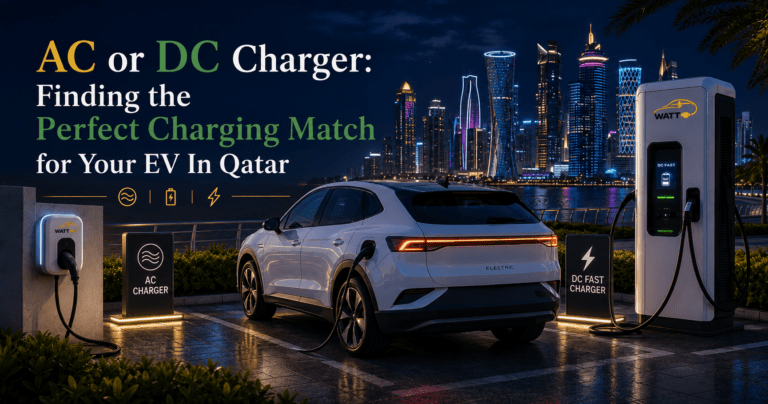
Before diving into Qatar-specific details, let’s clear up the basics. AC and DC aren’t competing technologies where one is “better” — they’re simply two different tools built for two different jobs.
What Is AC Charging and When Does It Make Sense?
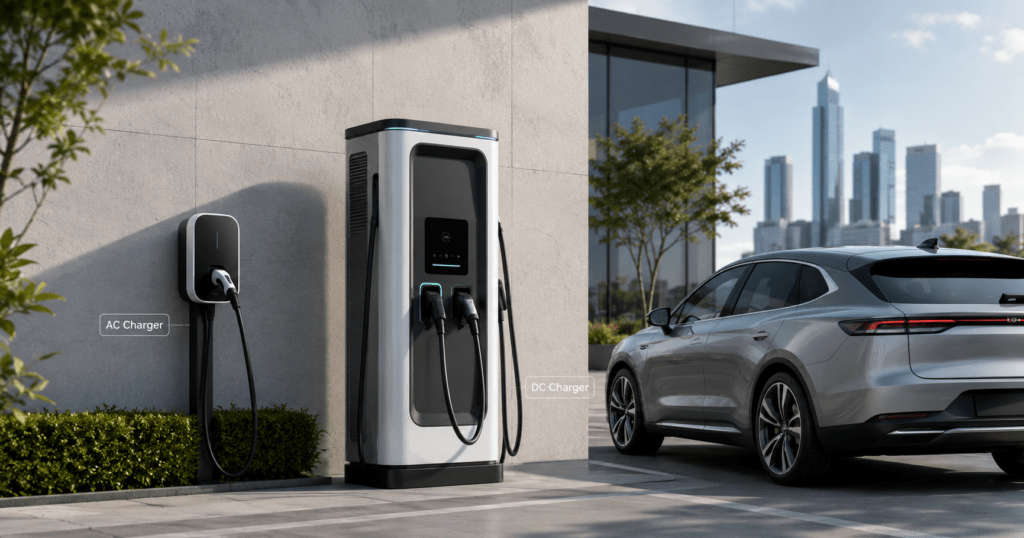
AC charging is the everyday workhorse of EV ownership. When you plug into an AC charger, electricity flows into your car as alternating current, and your vehicle’s onboard converter takes over from there — converting that AC power into the DC power your battery actually stores. This conversion step is exactly why AC charging is slower than DC. The car’s onboard hardware can only convert so much power at a time, no matter how strong the source is.
However, “slower” doesn’t mean “worse.” An AC charger is perfectly suited for situations where your car is going to sit for a while anyway — overnight at home, a full workday at the office, or a long stay at a hotel. Plug in before bed, wake up to a full battery, and never think about it again. For most electric car owners in Qatar, this is genuinely all they need day to day. If you’re also using an ac dc battery charger setup for other equipment at home, the same underlying principle applies: AC power gets converted on-site into usable DC energy.
What Is DC Fast Charging and When Do You Need It?
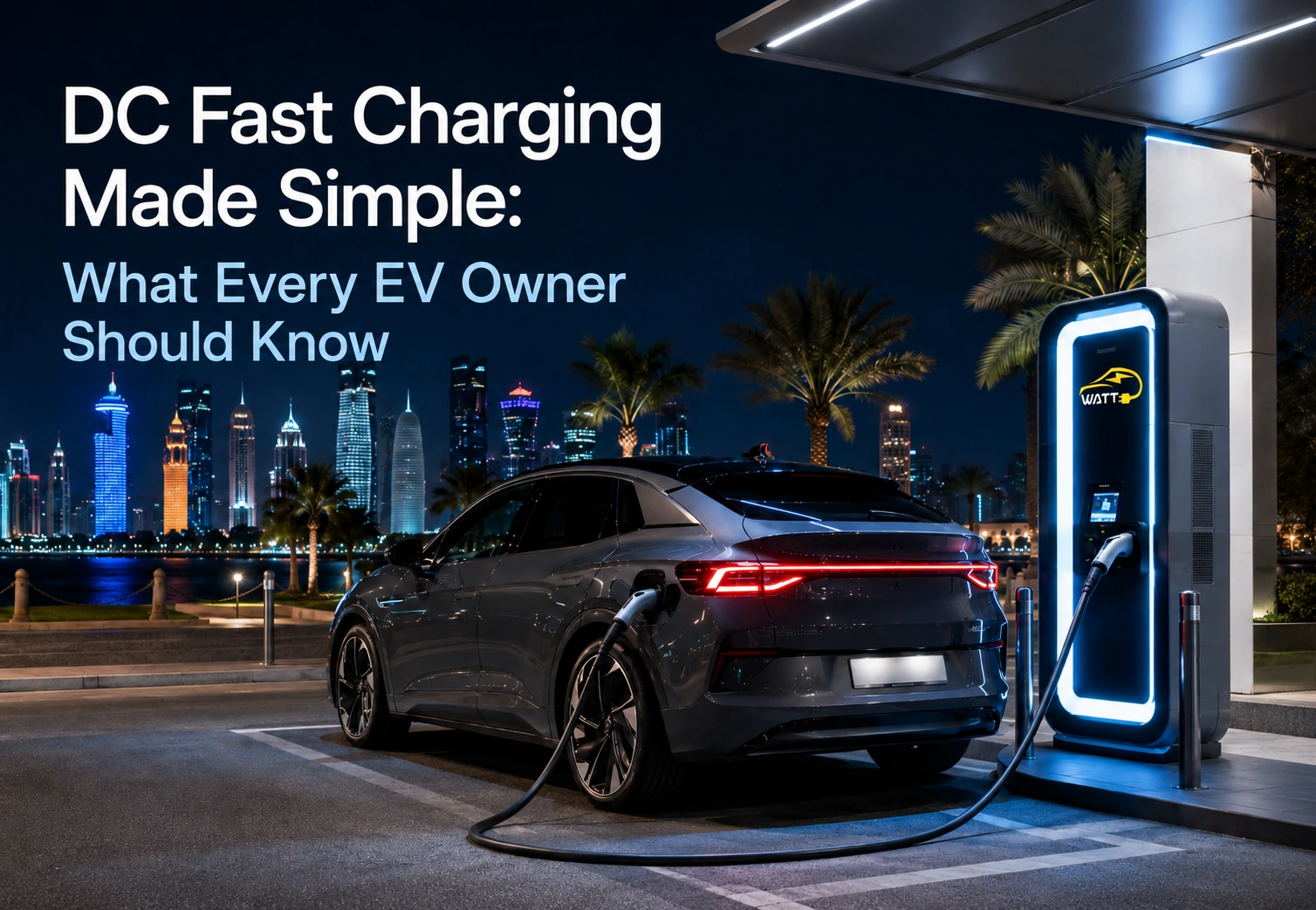
DC fast charging skips the onboard converter entirely. The charging station itself does the AC-to-DC conversion externally, then sends direct current straight into your battery. Because the car isn’t the bottleneck anymore, power delivery is dramatically faster.
This is where a DC fast charger earns its name. It’s built for moments when time matters — a quick top-up during a long drive across Qatar, a fleet vehicle that needs to get back on the road fast, or a commercial site serving dozens of drivers a day. For more advanced setups, you’ll also hear about DC-to-DC charger technology, which manages power transfer between batteries or auxiliary systems without an AC stage at all — common in fleet and commercial configurations. And if you’ve come across a 110 V DC battery charger in your research, that’s a reminder that voltage and current type both matter; DC systems in Qatar’s EV infrastructure are engineered around higher, standardised voltages designed specifically for rapid vehicle charging, not household equipment.
AC vs DC — The Honest Side-by-Side Breakdown
Here’s the comparison without the marketing spin
| Factor | AC Charger | DC Fast Charger |
| Charging Speed | Slower, ideal for overnight use | Much faster, ideal for quick top-ups |
| Installation Cost | More affordable | Higher upfront investment |
| Best Use Case | Homes, villas, offices, hotels | Fleets, public stations, commercial sites |
| Power Conversion | Car’s onboard converter handles it | Charger sends DC power directly |
| Running Style | Daily convenience | High vehicle turnover |
| Qatar Fit | Great for residential and workplace parking | Great for public and business charging |
Practical Comparison Checklist
Choose AC charging if:
-
- You mostly charge at home
-
- Your car stays parked for several hours
-
- You want a simple daily routine
-
- You prefer a lower installation cost
-
- You need a reliable home EV charger setup
Choose DC charging if:
-
- You manage several EVs
-
- You operate taxis, delivery vans, or company vehicles
-
- You want to attract EV customers to your location
-
- You need fast charging for public use
-
- You want scalable commercial charging infrastructure
What Type of EV Owner Are You?
Charger choice isn’t really about AC versus DC in the abstract — it’s about matching the setup to how you actually live and drive.
The Daily Commuter
If your typical day looks like drive to work, drive home, repeat — a home AC charger installed overnight is your ideal match. It’s simple, affordable, and it means you start every morning with a full battery without ever visiting a public charging station. This describes the majority of electric car drivers in Qatar, and honestly, it’s the easiest part of EV ownership once it’s set up.
The Fleet Manager or Business Owner
If you’re running a delivery fleet, a corporate car pool, or a commercial site with multiple vehicles cycling through daily, AC charging alone won’t keep up. A dc fast charger setup gives you the vehicle throughput and fast turnaround your operation needs, and it scales across multiple bays as your fleet grows. WATT’s fleet charging solutions are built specifically around this kind of high-demand, multi-vehicle environment.
The Long-Distance or Frequent Traveller
Maybe you split your time between Doha and other parts of Qatar, or you simply drive more than the average commuter. In that case, the smart approach is a combination: AC charging at home for your daily baseline and DC fast charging on the road when you need a quick boost. Qatar’s growing network of public electric car charging stations is making this combination genuinely practical, not just theoretical.
EV Charging in Qatar — What You Need to Know Right Now
EV charging in Qatar has moved well past the early-adopter phase. Electric cars in Qatar are becoming a common sight on the roads, and public charging infrastructure is expanding steadily to match that growth, supported in part by initiatives like the Kahramaa Green Charger program.
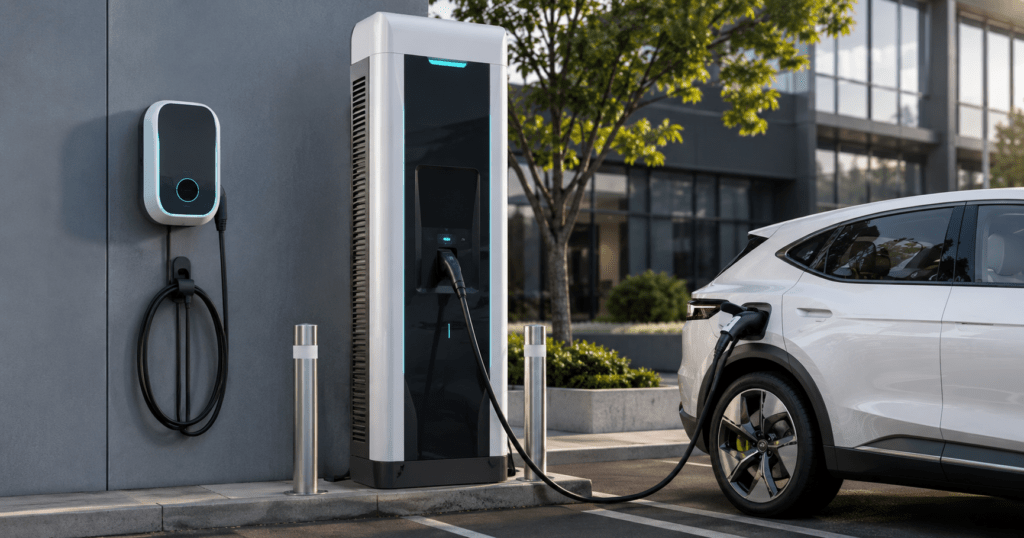
That expansion brings responsibility with it. Any EV charger installation in Qatar — home or commercial — needs to meet Kahramaa compliance requirements. This isn’t bureaucratic red tape; it’s what protects your home’s electrical system, your vehicle’s warranty, and your family’s safety. A poorly installed charger, especially a DC unit, can create real electrical risk if load balancing and charge controller settings aren’t configured correctly by someone who actually understands the system.
That’s exactly why choosing the right installer matters as much as choosing the right charger type. Among the EV charging companies operating in Qatar today, WATT has built its reputation specifically around doing this part properly — every time.
The Cost Question — AC vs DC Installation in Qatar
Let’s talk numbers honestly, because both charger types are investments, and it’s worth understanding what you’re actually paying for.
AC installation for a home setup is significantly more affordable. You’re working with single-phase or three-phase AC infrastructure that’s relatively straightforward to install and doesn’t require heavy-duty electrical upgrades in most homes. For the average electric car Qatar owner, this is a manageable, worthwhile investment that pays off in daily convenience.
DC fast charger installation costs more — the equipment itself is more sophisticated, and site preparation (power supply upgrades, dedicated transformers in some cases) adds to the bill. However, for commercial sites and fleet operations, that upfront cost delivers real ROI through faster vehicle turnaround, higher site utilisation, and the ability to serve more drivers or vehicles per day. Viewed that way, it’s not an expense — it’s infrastructure that pays for itself over time.
Why WATT Is Qatar’s Most Trusted EV Charging Partner
Once you know which charger fits your situation, the next step is getting it installed properly — and this is where WATT comes in. WATT handles the entire EV charger installation journey from start to finish: a proper site survey to assess your electrical setup, equipment selection matched to your vehicle and usage pattern, Kahramaa-compliant installation carried out by qualified technicians, network activation, and ongoing support after the job is done.
WATT’s ev charger solutions are compatible with every major EV brand on Qatar’s roads today — Tesla, BMW, BYD, Kia, NIO, Hyundai, Audi, Porsche, Volvo, MG, and XPeng. Whether you need a straightforward home ev charger for overnight AC charging or a full dc fast charger setup for a commercial site, you’re working with one team, one contract, and one point of accountability. As one of the established ev charging companies in Qatar, WATT takes the guesswork — and the risk — out of the process entirely.
Final Thought
There’s no single “best” charger between AC and DC — there’s only the right one for how you actually live and drive. A daily commuter, a fleet manager, and a long-distance traveller will each land on a different answer, and that’s exactly how it should work. What matters is getting a setup that fits your lifestyle, your vehicle, and your location in Qatar — installed safely, compliant with Kahramaa standards, and built to last.
Visit WATT today — and let Qatar’s most trusted EV charging partner match you with the right charger for your car, your home, and your lifestyle.
Contact WATT to get started.
Frequently Asked Questions
1. Do I need both an AC and a DC charger for my EV in Qatar?
Most personal EV owners only need an AC charger at home. DC fast charging becomes relevant if you travel long distances often or manage multiple vehicles.
2. Is DC fast charging bad for my car’s battery over time?
Occasional DC fast charging is safe for modern EVs. Relying on it exclusively, rather than mixing in regular AC charging, is generally not recommended by manufacturers.
3. How long does a Kahramaa-compliant EV charger installation take in Qatar?
Timelines vary by property and equipment type, but a professional site survey followed by compliant installation typically takes a few days from start to finish.
4. Can I install a DC fast charger at home in Qatar?
It’s technically possible but rarely necessary for personal use, given the higher cost and power requirements. Most homeowners get better value from a properly installed AC charger.
5. Are all electric cars in Qatar compatible with WATT’s charging solutions?
Yes — WATT’s charger installations support all major EV brands on Qatar’s roads, including Tesla, BMW, BYD, Kia, NIO, Hyundai, Audi, Porsche, Volvo, MG, and XPeng.