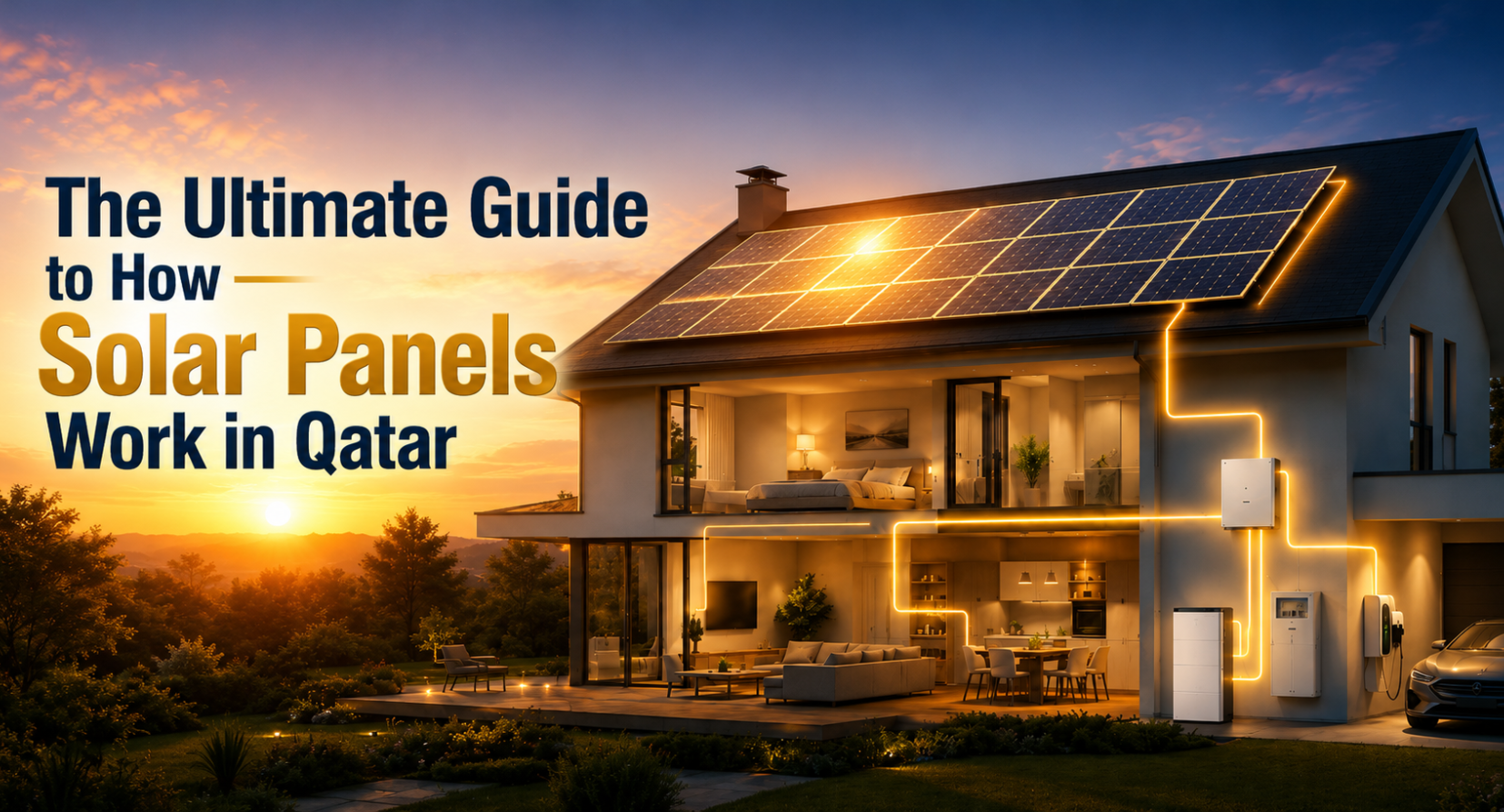
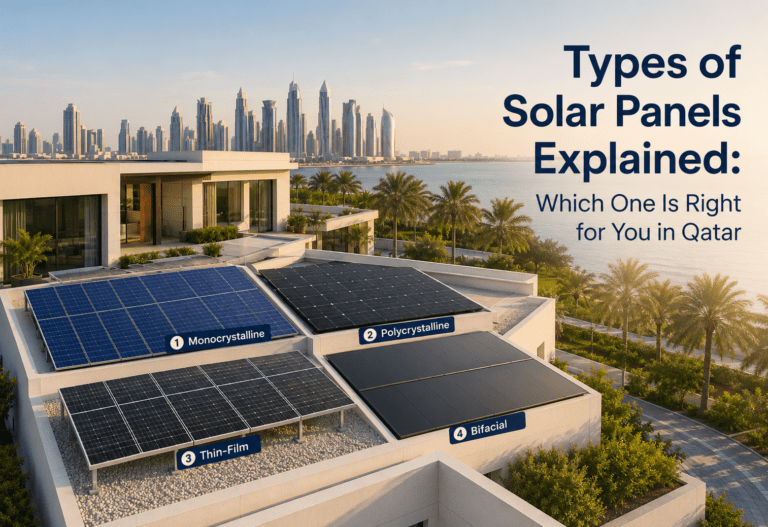
Three Quotes, Three Different Panel Types — And No Idea Which One Is Right
You are standing on your Doha rooftop with three solar quotes in hand. One installer recommends monocrystalline panels. Another says polycrystalline panels will save money. A third talks about bifacial panels and reflected light gain.
Now you are not choosing solar anymore. You are trying to decode technical language.
That confusion is common. Solar panels in Qatar are not all built for the same roof, budget, or energy goal. The right choice depends on available space, heat exposure, daily electricity use, shading, battery plans, and long-term performance.
Qatar solar energy is also moving from a future idea to a practical investment. Kahramaa’s BeSolar service supports distributed solar energy systems and a net billing mechanism for customers, while Qatar’s renewable strategy targets 4 GW of utility-scale renewable capacity and 200 MW of distributed renewable generation by 2030.
The Main Types of PV Panels — Explained Without the Jargon
Most solar buyers compare four main types of PV panels. Each type has a real advantage, but each one also has a tradeoff.
Monocrystalline Panels — The Efficiency Leader
Monocrystalline panels usually offer the strongest efficiency among mainstream solar panel options. They use single-crystal silicon, which helps them produce more power from the same roof area.
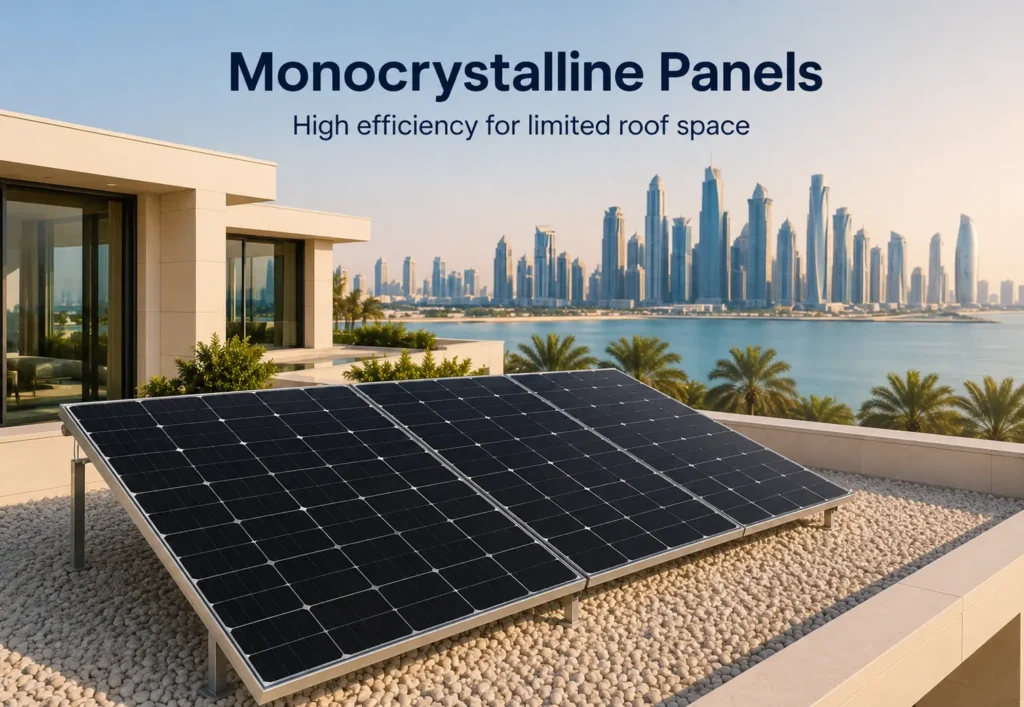
For a Doha villa, this matters. Roof space may be limited, while air-conditioning demand can be high during the day. If you want stronger electric solar panel output per square metre, monocrystalline panels often make the most sense.
The tradeoff is cost. They usually cost more upfront, but they can give better long-term value when space is tight.
Polycrystalline Panels — The Budget-Conscious Choice
Polycrystalline panels use multiple silicon fragments instead of one single-crystal structure. This usually makes them more affordable than monocrystalline panels.
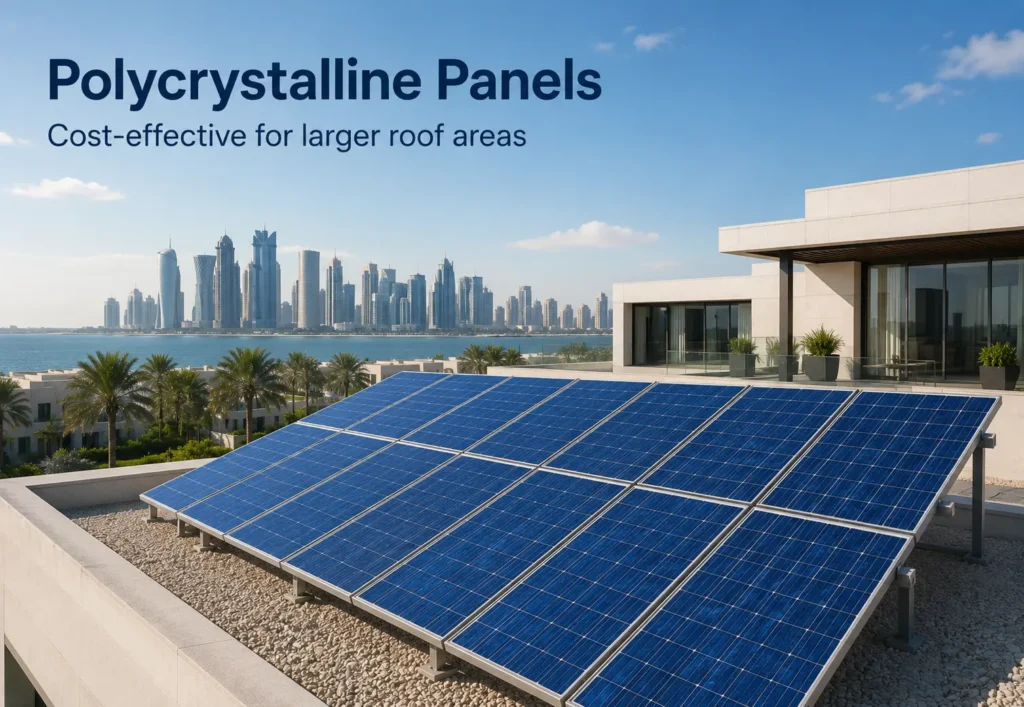
They are slightly less efficient, so they need more roof area to produce similar output. However, that is not always a problem. Large villas, warehouses, factories, staff accommodation, and commercial rooftops may have enough space to make polycrystalline a practical choice.
If you are comparing cheap solar panels, check more than the price. Heat performance, warranty, local support, and system design matter more than saving a small amount on day one.
Thin-Film Panels — Lightweight and Flexible
Thin-film panels are lighter than traditional crystalline panels. They can work on some curved, lightweight, or temporary surfaces where normal framed panels are not ideal.
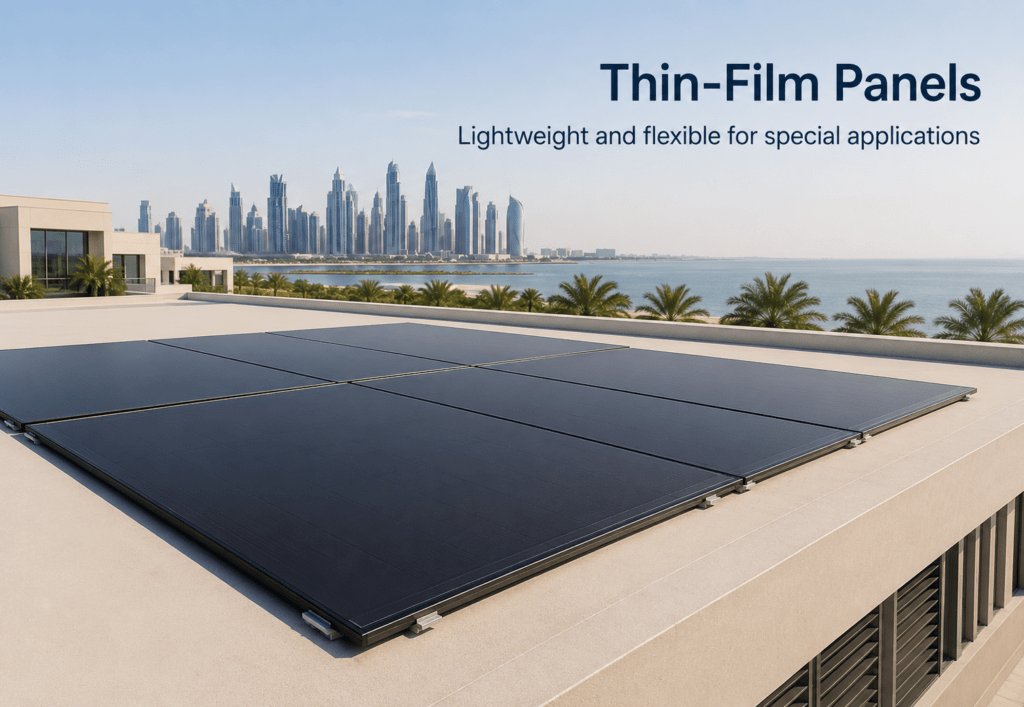
However, thin-film panels usually need more area to produce the same power. They may also have a shorter practical lifespan depending on the product and installation environment.
For most solar panel Qatar villa and commercial rooftop projects, thin-film is not the first choice. It is better for specific applications, portable use, or unusual surfaces.
Bifacial Panels — Capturing Reflected Light
Bifacial panels capture sunlight from the front and reflected light from the back. In Qatar, this can be useful because bright rooftops, reflective ground surfaces, and open desert-style environments can send extra light onto the rear side of the panel.
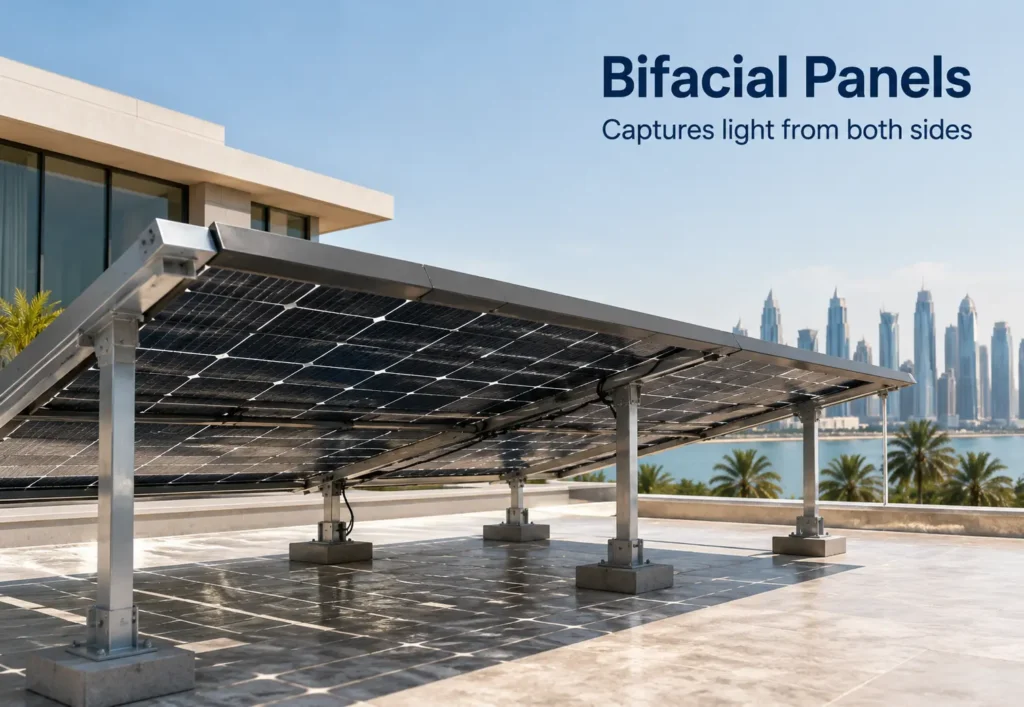
That makes bifacial panels an interesting part of Qatar solar technologies. They can be especially useful for ground-mounted systems, open commercial spaces, and reflective rooftops.
However, they need the right layout. Mounting height, spacing, surface reflection, and airflow all affect performance. Without proper design, the extra cost may not deliver enough value.
Quick Comparison: Which Panel Type Fits Your Need?
| Panel Type | Best For | Main Advantage | Main Tradeoff |
| Monocrystalline | Villas, limited roof space, premium systems | Higher output per square metre | Higher upfront cost |
| Polycrystalline | Large roofs, warehouses, cost-sensitive projects | Lower panel cost | Needs more roof area |
| Thin-Film | Portable, curved, temporary, lightweight surfaces | Flexible and lightweight | Lower efficiency |
| Bifacial | Reflective rooftops, ground mounts, open spaces | Captures light from both sides | Needs correct installation design |
Why Qatar’s Climate Changes the Panel Decision
In Qatar, panel choice is not only about efficiency on a spec sheet. Heat changes the real result.
Solar panels lose some output as panel temperature rises. This is why temperature coefficient matters. A panel with slightly lower brochure efficiency but stronger heat tolerance may perform better during Qatar’s hottest months than a higher-rated panel with weaker heat handling.
Dust also matters. Even a strong solar panel energy system needs correct tilt, cleaning access, quality mounting, and maintenance planning.
This is where Qatar renewable energy planning becomes practical. Qatar’s National Vision 2030 connects environmental development with long-term sustainability, and Qatar’s official strategy is pushing renewable energy into real infrastructure, not just policy language.
Experienced solar companies in Qatar do not simply recommend the cheapest option. They look at:
- Roof direction and usable space
- Shade from nearby walls, tanks, and buildings
- Heat exposure and ventilation
- Dust accumulation risk
- Inverter placement
- Cleaning and maintenance access
- Future battery or EV charging needs
Matching Panel Type to Your Actual Use Case in Qatar
The best panel type depends on what you want the system to do.
Residential Villas
For a solar system for house use, monocrystalline panels usually work best. Villas often have limited roof space, and daytime cooling demand can be high. Higher-efficiency panels help produce more energy from the available area.
Commercial and Industrial Buildings
For a commercial rooftop or solar plant Qatar project, polycrystalline or bifacial panels may make sense when the roof or ground area is large. The decision depends on available surface area, mounting structure, total energy target, and budget.
Off-Grid and Temporary Sites
For an off-grid solar system in Qatar, panel choice is only one part of the setup. Temporary power solutions Qatar for construction sites, farms, events, and remote facilities may use portable solar panels with inverters and lifepo4 battery Qatar storage.
This type of setup gives reliable power where grid access is limited or where temporary energy independence is needed.
Solar-Powered Cooling
Solar-powered cooling is becoming more attractive because Qatar’s cooling demand often rises when sunlight is strongest. A solar air conditioner or solar-powered air conditioner setup can reduce daytime grid draw and support better energy planning for villas, offices, and commercial spaces.
Buyer Checklist: What to Check Before Choosing Solar Panels
Before approving a quote, check these points:
- Do I have enough usable roof space?
- Is my roof shaded during the day?
- Which panel type suits my energy goal?
- Does the panel have good heat tolerance?
- Is the mounting structure suitable for Qatar’s climate?
- Is the system designed for cleaning access?
- Does the quote include inverter sizing?
- Do I need battery storage now or later?
- Is the installer experienced in local conditions?
- Is the warranty supported by local service?
This checklist helps you compare quotes properly instead of choosing only by the lowest price.
Don’t Forget the Solar Inverter — It Matters as Much as the Panel
Even the best panels cannot perform properly without the right solar inverter. The inverter converts solar electricity into usable power for your home or business.
In Qatar, inverter heat tolerance matters. Poor ventilation, incorrect sizing, or weak inverter quality can reduce system output even if the panels are excellent.
Some buyers search “solar invert” when they mean solar inverter. Either way, do not ignore this component. It controls conversion efficiency, system safety, monitoring, and long-term performance.
A strong solar quote should clearly explain:
- Inverter type
- Inverter capacity
- MPPT performance
- Battery compatibility
- Monitoring options
- Warranty and local support
Solar Panel Price in Qatar — What Drives the Cost Difference
Solar panel price in Qatar depends on more than panel type. The final cost changes based on system size, inverter quality, mounting structure, wiring, battery storage, access difficulty, and after-sales support.
Monocrystalline panels usually cost more upfront but produce more energy per square metre. Polycrystalline panels may cost less but need more space. Thin-film and bifacial panels sit in different price-performance ranges depending on the project.
The smarter question is not, “Which panel is cheapest?” The better question is:
What will this system cost per kWh over its working life?
A weak solar supply can look attractive at first, but it may cost more later through poor output, faster degradation, limited warranty support, and higher maintenance needs.
Final Selection Checklist
Choose monocrystalline if:
- Roof space is limited
- You want higher output per square metre
- Your villa has high daytime cooling demand
- You prefer long-term efficiency over lowest upfront price
Choose polycrystalline if:
- You have large roof space
- Budget control matters
- Your energy target can be met with more panels
- You want a practical commercial option
Choose thin-film if:
- The surface is lightweight or unusual
- You need a portable or temporary setup
- Flexibility matters more than maximum efficiency
Choose bifacial if:
- The site has reflective ground or roof surfaces
- The system is ground-mounted or open
- The layout allows rear-side light capture
- You want extra output from smart design
How WATT Helps You Choose the Right Panel Type
WATT helps homeowners, businesses, developers, and facility managers choose solar systems based on real site conditions, not generic product pushing.
As one of the trusted suppliers in Qatar and one of the solar energy companies supporting clean energy adoption, WATT can assess your roof, energy usage, budget, inverter requirement, battery options, and future expansion plans.
WATT can help with:
- Solar panel selection
- Solar inverter configuration
- Battery storage planning
- Rooftop and commercial system design
- Off-grid and hybrid solar solutions
- Maintenance and performance support
The goal is simple: match the right panel type to the right property, so the system performs well in Qatar’s real climate.
Visit WATT* today — and let Qatar’s trusted solar experts match the right panel type to your roof, your budget, and your energy goals.*
Frequently Asked Questions
1. Which type of solar panel is best for homes in Qatar?
Monocrystalline panels are often the best choice for villas because they produce more power from limited roof space. However, the final choice depends on roof size, shading, electricity use, cooling demand, and budget.
2. Are cheap solar panels worth it in Qatar?
Cheap solar panels can work if they come with proper warranty, heat performance, and local support. However, choosing only by the lowest price can reduce long-term value in Qatar’s hot and dusty climate.
3. Does panel type affect solar panel price in Qatar?
Yes. Monocrystalline and bifacial panels usually cost more than polycrystalline panels. Thin-film pricing depends on application. However, total system cost also includes inverter, mounting, wiring, batteries, installation, and maintenance support.
4. Can solar panels support air conditioning in Qatar?
Yes, a well-designed solar system can help offset daytime cooling loads. Solar-powered cooling works especially well because peak sunlight often overlaps with peak air-conditioning demand.
5. What should I ask before choosing a solar company?
Ask about panel type, heat tolerance, inverter sizing, battery options, cleaning access, warranty, previous Qatar installations, maintenance support, and total cost-per-kWh over the system life.